News

Nanobots and the Evolution of Intelligence

What if intelligence could evolve without a brain? What if life could replicate without DNA? We’re entering an era where those questions aren’t just science fiction—they’re becoming scientific engineering. The convergence of nanotechnology, neural networks, and molecular self-assembly could give rise to a new kind of intelligence—one that’s self-replicating, adaptive, and not bound to biology. In this post, we explore the cutting edge of AI evolution, where molecular-scale robots could one day form the basis of a living, learning artificial ecosystem.

Read more
Nanobots and the Evolution of Intelligence

The First Steps of Artificial Minds

Artificial intelligence is no longer just about smarter apps or smoother conversations with Siri. We're now brushing up against far deeper questions—questions that poke at the very boundaries of life, intelligence, and consciousness. Can AI become self-aware? If so, what are the first sparks of that awareness? In this post, we dig into the roots of AI self-reflection, explore how agent-based networks mimic the brain’s architecture, and peek into the potential of nano-swarm intelligences—tiny artificial entities that might one day grow into something eerily close to life itself.

Read more
The First Steps of Artificial Minds

The Cycle of Objects: Life, Death, and the Limits of Understanding

Everything we interact with—whether physical or conceptual—follows a natural cycle: it comes into existence, evolves, and eventually ceases to be relevant. This cycle applies to everything from physical objects to ideas, scientific models, and technological frameworks. Objects do not exist in isolation—they are often embedded within other objects, much like Russian nesting dolls, where each layer contains and depends on the one before it (Minsky, 1986). This layered nature of objects influences how we perceive and interact with reality. Our sensory experience is inherently limited, revealing only surface interactions rather than the true essence of things. Just as a video game’s physics system operates based on complex code that looks nothing like what appears on the screen, reality itself may be governed by deeper structures that are inaccessible to direct observation. What we see and touch is merely an interface for a much more mysteriously hidden system (Turing, 1936).

Read more
The Cycle of Objects: Life, Death, and the Limits of Understanding

New Brains, Old Mistakes: Humanity’s Amnesia

Cities are buckling under their own weight. Infrastructure is neglected and crumbling. Even in Australia—where we pride ourselves on working smart—it’s clear we’re running on borrowed time. Beneath the cracks in the old sidewalk pavement lies something deeper: a collapse of true purpose, replaced with compulsive consumerism. The institutions we once trusted to build the future—education, government, media—now play a different game. A game where winning at all costs matters more than real purpose. Where short-term gains eclipse long-term stability. Where competition is strength, and cooperation is weakness. This strength mentality has seeped into families and communities. We are witnessing a surge in violence, authoritarian parenting models, and the perfunctory kindness that exists only for social likes—not genuine compassion.

Read more
New Brains, Old Mistakes: Humanity’s Amnesia

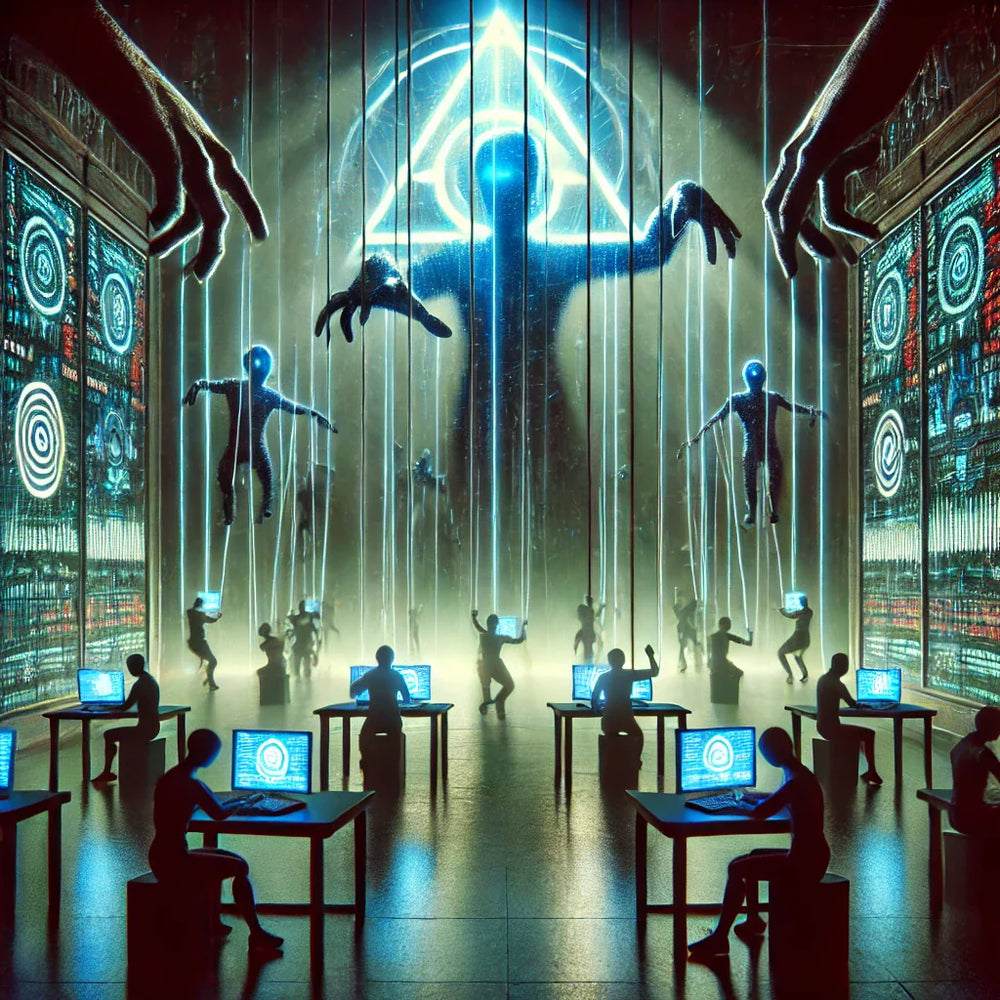
The Death of True Virality: How Social Media Became a Controlled Information Flow for Profit

The internet was once hailed as the great equalizer, a boundless expanse of knowledge, creativity, and connection where true merit could shine. Virality was once a measure of genuine engagement—a video, article, or idea spreading organically because it resonated with people. However, social media today has become the exact opposite: an intricate, carefully controlled system where visibility, reach, and engagement are not dictated by quality or merit but by a revenue-driven algorithmic machine designed to keep users hooked, distracted, and spending. This modern, human-created matrix is systematically lowering both the emotional intelligence (EQ) and intellectual intelligence (IQ) of the general population while fostering a culture of misinformation, superficiality, and false narratives.

Read more
The Death of True Virality: How Social Media Became a Controlled Information Flow for Profit

Universal Basic Income: A Tool, Not the Destination

What if we stopped asking whether people “deserve” support—and instead asked what kind of society we want to build together? In the face of rising inequality, automation, and deepening societal stress, Universal Basic Income (UBI) has emerged as one of the most compelling policy ideas of our time. It promises every citizen a dignified economic floor. But a floor is not a home. If UBI stands alone—divorced from structural reform—it risks becoming a band-aid on a broken system. We don’t just need cash.We need control, context, and community. That’s where the Civic Equity System comes in.

Read more
Universal Basic Income: A Tool, Not the Destination

The Power of World-Building: Crafting Universes That Breathe

World-building is a crucial aspect of storytelling that cannot be overlooked, regardless of the genre or style of book you are writing. Whether you are creating an entirely new universe or setting your story in an established historical period, a thorough understanding and detailed mental model of the world are indispensable. This process involves asking a series of "what if" questions that lead to explosive changes and rich, immersive settings. In this blog post, we will delve into the importance of world-building, methods to achieve it, and why it is essential for every writer.

Read more
The Power of World-Building: Crafting Universes That Breathe

Understanding the Human Condition Through Aedan: Evolution, Environment, and the Making of a Hero

To write powerful heroes and formidable villains, an author must understand life itself—its evolution, its forces, and its frailties. In Manah Wars: Glimmer in the Darkness, Aedan is not simply a character; he is a vessel through which the philosophical interplay of nature, nurture, and the soul is explored. His journey allows us to examine how environmental conditioning, the blank slate of tabula rasa, genetic potential, and even epigenetics shape the trajectory of a character’s arc—and how the ability to establish or lose personal boundaries defines the line between hero and villain.

Read more
Understanding the Human Condition Through Aedan: Evolution, Environment, and the Making of a Hero

The Writing Industry's Quantity Over Quality Dilemma: How It Stifles Great Writers and Fosters Echo Chambers

The landscape of the writing industry has drastically evolved in recent decades. Once driven by the pursuit of literary excellence and the nurturing of profound storytelling, today's industry is increasingly influenced by market dynamics that prioritize quantity over quality. This shift has profound implications, drowning out great writers and encouraging a proliferation of subpar genre fiction that fuels tribalistic echo chambers. This article explores the multifaceted consequences of this trend, delving into its origins, impacts, and potential remedies.

Read more
The Writing Industry's Quantity Over Quality Dilemma: How It Stifles Great Writers and Fosters Echo Chambers

Crafting a Captivating Story by Starting with the End Scene in Mind: Lessons from Glimmer in the Darkness

One of the most effective tools in the epic storyteller’s arsenal is to begin with the end. By envisioning your climax first and working backward through the Hero’s Journey, you ensure that every plot beat, transformation, and setback has purpose. In Glimmer in the Darkness, the journey of Aedan—from wounded hunter to reluctant hero—is shaped precisely this way. This isn’t theory. This is craft, practiced and executed across a war-torn, manah-soaked world called Alteria.

Read more
Crafting a Captivating Story by Starting with the End Scene in Mind: Lessons from Glimmer in the Darkness